
How to set up a home office?
The current situation has forced us to change our way of life, and in many cases, our way of working too. Quite a few people have swapped their office at work for one in the comfort of their own home. But then again – can we really call it ‘the comfort of home’? Given the challenge of juggling remote working with looking after children, many parents would surely be at their wits’ end when thinking back on their recent experiences. Pausing video conferences to answer their little ones’ endless questions, the constant “Mum!” and preparing meals for the whole gang. Is it the same for you too? You’re not alone! After four months, we’re starting to see the pros and cons of remote working. We can also draw conclusions about how we work most effectively. We already know what conditions are conducive to working from a home office. Of course, the ideal situation is being able to set aside a separate room as an office, as this keeps the chaos of home life behind closed doors. However, many people don’t have this option due to limited space and the need to share it with other members of the household. In the text below, we offer tips on how to set up a space for work and concentration in a small, home environment.
Assess your needs
Every profession requires different tools. When working from home, those who only need a laptop are in the best position. It takes up little space, so it’s easy to carve out a spot for an office. However, there are those who work with documents and need somewhere to store them. Over the years, each of us has developed our own way of carrying out our duties. Some people can’t imagine working amidst a mess, whilst others only come up with their best ideas when surrounded by chaos. Or perhaps the constraint is your working hours? If your working hours are fixed, you need to take even greater care to ensure your workspace gives you peace and quiet and doesn’t distract you. Especially as home life comes with a never-ending list of chores. Looking around, we see just how much we have to do – putting a wash on, cooking dinner, and so on. To sum up – a home office should be tailored to the type of work you do and the space available, but also to the rest of the household.
Comfort comes first! Remember to prioritise ergonomic working practices and choose a suitable colour scheme for the interior
Regardless of the type of work and how you carry it out, look for a quiet spot in your home. If you can’t set aside a separate room, choose a place that isn’t on a main thoroughfare, especially if you share your home with others. It’s a good idea to set aside a dedicated workspace so that the rest of the room isn’t associated with work. Whilst it’s very tempting to work from bed in your pyjamas at the start of your remote working journey, when working from home full-time, it’s best to establish the same routines as you would when going to the office.
When looking for the right spot for your desk, there are a few things to bear in mind. Firstly, lighting – position your desk opposite or next to a window. This will give you access to natural light that won’t reflect off your monitor. And if you need to supplement your workspace with artificial light, opt for cool-toned lighting – this colour causes the least eye strain. Also check where the nearest socket is to avoid having cables strewn across the middle of the room. We know from experience that it’s difficult to follow all the rules of ergonomic computer use at home, but it’s worth bearing them in mind when planning your office. We strongly recommend focusing on choosing the right chair. Remember that even the most comfortable workstation doesn’t mean you can stop moving! Take 5 minutes every hour to ‘stretch your legs’.
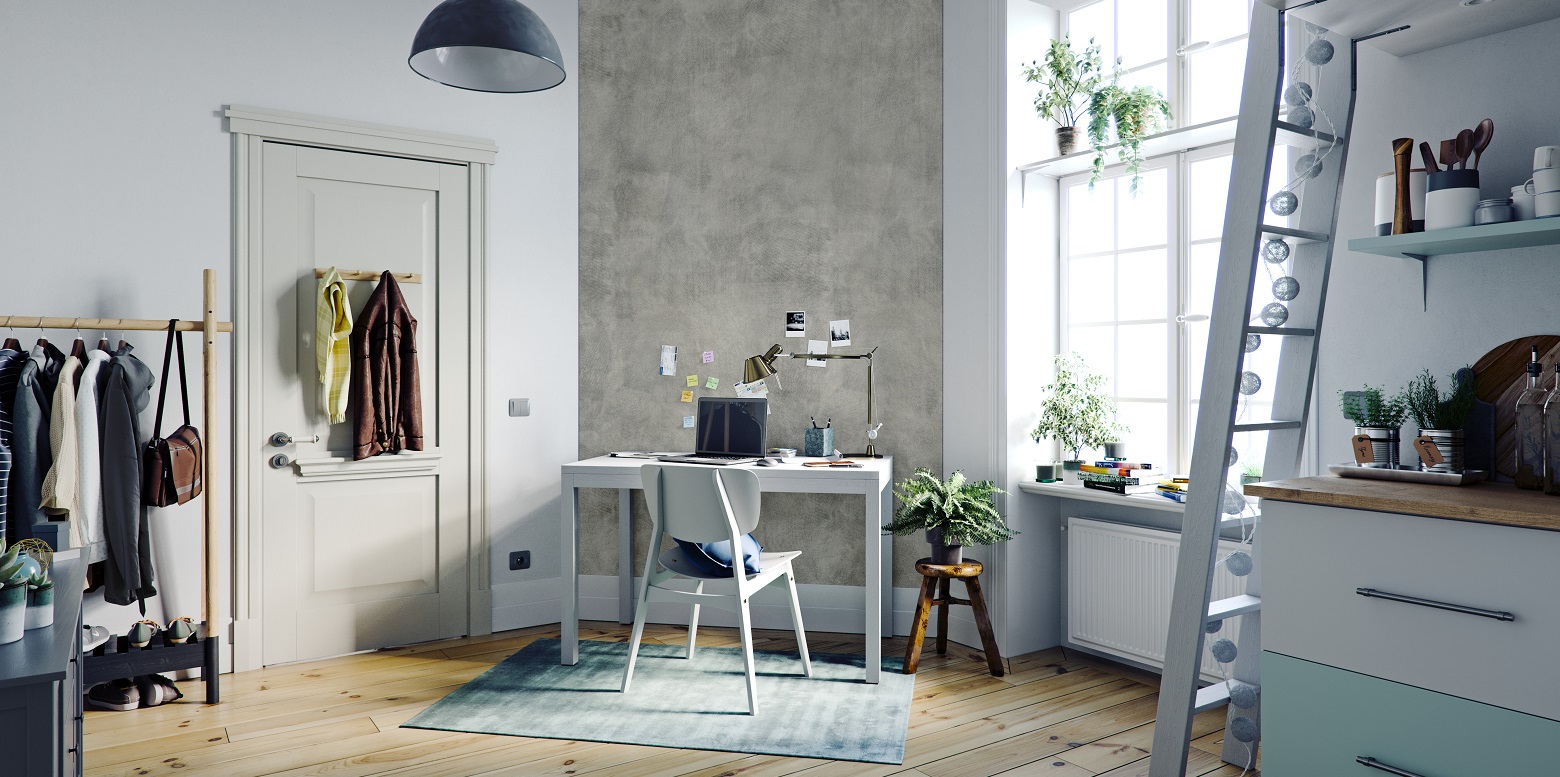
To improve your concentration, make sure you choose the right colour scheme too. It should be consistent with the rest of the interior, but ideally in muted tones. Safe choices include various shades of grey and white, or – for those who prefer bolder accents – a muted green. It’s a good idea to highlight your workspace with a different colour or pattern on the wall. You can do this easily with a Motivo decorative wall panel. The range includes plenty of calming designs, and you can fit them yourself by sticking the panels directly onto the wall. Motivo can also serve as a board for pinning up notes or photos. You might also consider adding motivational quotes or goals to remind you of what you want to achieve. It’s also worth thinking about adding some plants. They’ll make the space more pleasant, and the greenery will give your eyes a rest from the screen whilst helping to improve your concentration. If your space allows it, you might consider partitioning off your workspace with an open-plan bookcase – one with access to the shelves from both sides. This will give you a bit of privacy in your office as well as extra storage space. Just remember not to let this arrangement block out the light.
Keep things tidy
It sounds like a cliché, but it really does make work easier. Whilst tidiness whilst working is very much a personal matter – some people simply cannot concentrate if they see a mug with coffee grounds on their desk – tidiness is crucial once you’ve finished work. When working remotely, we can’t simply walk out of the office and forget about work. That’s why it’s important not to have bits of paper and work items lying about in your home office, so you can relax with peace of mind. A good solution is to use storage boxes that slide under the desk, where you can tuck away all unnecessary items, as well as documents.
In addition, you should think about the other members of the household who may not necessarily want to be part of the office environment. Let’s not forget about the younger members of the household either. Keeping things tidy will prevent, for example, a very important contract from being drawn on or stained. And speaking of which – what about the children whilst you’re working from home? Unfortunately, this requires greater effort, as parents are effectively doing two jobs at once. What worked for us was planning our working day in advance alongside the children’s ‘school’ day. During online meetings, we recommend planning independent tasks for your little ones straight away. It’s hard to suggest a single solution, as every child is different, but where possible, think about gently involving your little one in your work. You could ask them to draw something related to your work or simply a portrait of you at work. And to make the task more interesting, use ingredients from the kitchen to make your own natural paints together. You’ll find the recipe here. Of course, it’s hard to stick rigidly to these plans, as there are often family emergencies. However, this will help establish a routine similar to leaving the house for nursery, school or work.
An office in the kitchen? Why not!
In small flats, there’s often no room for a desk. You can use the kitchen table for work. Unfortunately, this means you’ll have to set up and clear away your work tools every day, but it does have its advantages. Once you’ve finished your work, you can put everything away in its designated place and enjoy your free time.