
How to decorate a boy’s bedroom?
When planning a room for a boy, focus first and foremost on his needs and interests. Whatever your son’s age, don’t be afraid to ask for his opinion right from the planning stage. Unrealistic ideas can be sensibly ruled out. After all, there isn’t room for everything in the home. And it is your son who will be spending the most time in this room, so he needs to feel comfortable there. That’s why you should avoid decorating your child’s room solely according to your own taste. A lot depends on the boy’s age – whether he already needs a suitable space to concentrate and study, or whether play is still his main ‘task’. Remember, however, that right from the start of creating a space for your child’s development and rest, it’s worth ensuring that expensive items, such as a wardrobe, are versatile in terms of design and colour scheme. This will stand the test of time as your son grows up. Involve your child not only in the planning but also in helping with the redecoration. Painting the walls together can be great fun!
Start by choosing a colour scheme
There’s long been a belief that a boy’s room must be blue. If your son likes this colour, by all means focus on it. But breaking away from this stereotype can also yield great results. The theme should be based on the child’s interests. Don’t force trends, such as a nautical style. Also remember that a child’s interests can change as they grow older. So if your son likes football, consider football-shaped cushions rather than buying a bed with the same theme straight away. Replacing accessories is much cheaper and easier than changing the furniture.
Many parents may be tempted by a monochromatic colour scheme for a child’s bedroom, as they want it to look neat and tidy. However, this may not entirely align with the children’s vision, as they often prefer vibrant interiors. When looking for a compromise, opt for two main colours. The colours around us affect us and how we feel in a given space, so take a moment to choose them carefully. An overly colourful room can overstimulate a child, so find a balance. For the walls, it’s best to choose pastels and muted shades, whilst for the furniture, opt for neutral colours. Remember that toys come in a variety of colours and will bring joy to the room. Intense colours on the walls can make a room appear smaller. However, if you’re dreaming of a bolder colour on the wall, consider the recently trendy technique of painting only part of the wall – for example, a horizontal strip starting from the bottom – whilst leaving the upper section in off-white or a lighter shade of the same colour.
There are currently plenty of interesting ideas for walls on the market that serve more than just an aesthetic purpose. A great idea is to paint the wall – or part of it – with paint suitable for chalk drawing. This means your child’s creativity isn’t limited to a sheet of paper, and keeping such a wall clean is very easy. Another interesting option is magnetic paint, which allows magnets to stick to the surface. You can also combine these two types of paint: first, paint the wall with magnetic paint, and then with chalkboard paint. Remember, too, that blackboard paint doesn’t have to be black! There are paints available in various colours on the market, so you can match it to your décor, and it’s sure to bring plenty of joy to the whole family. If you want to decorate a wall in your child’s room with a specific theme, you can look for ready-made painting stencils. In no time at all, you can have balloons or cars drawn on the wall to keep your child company.
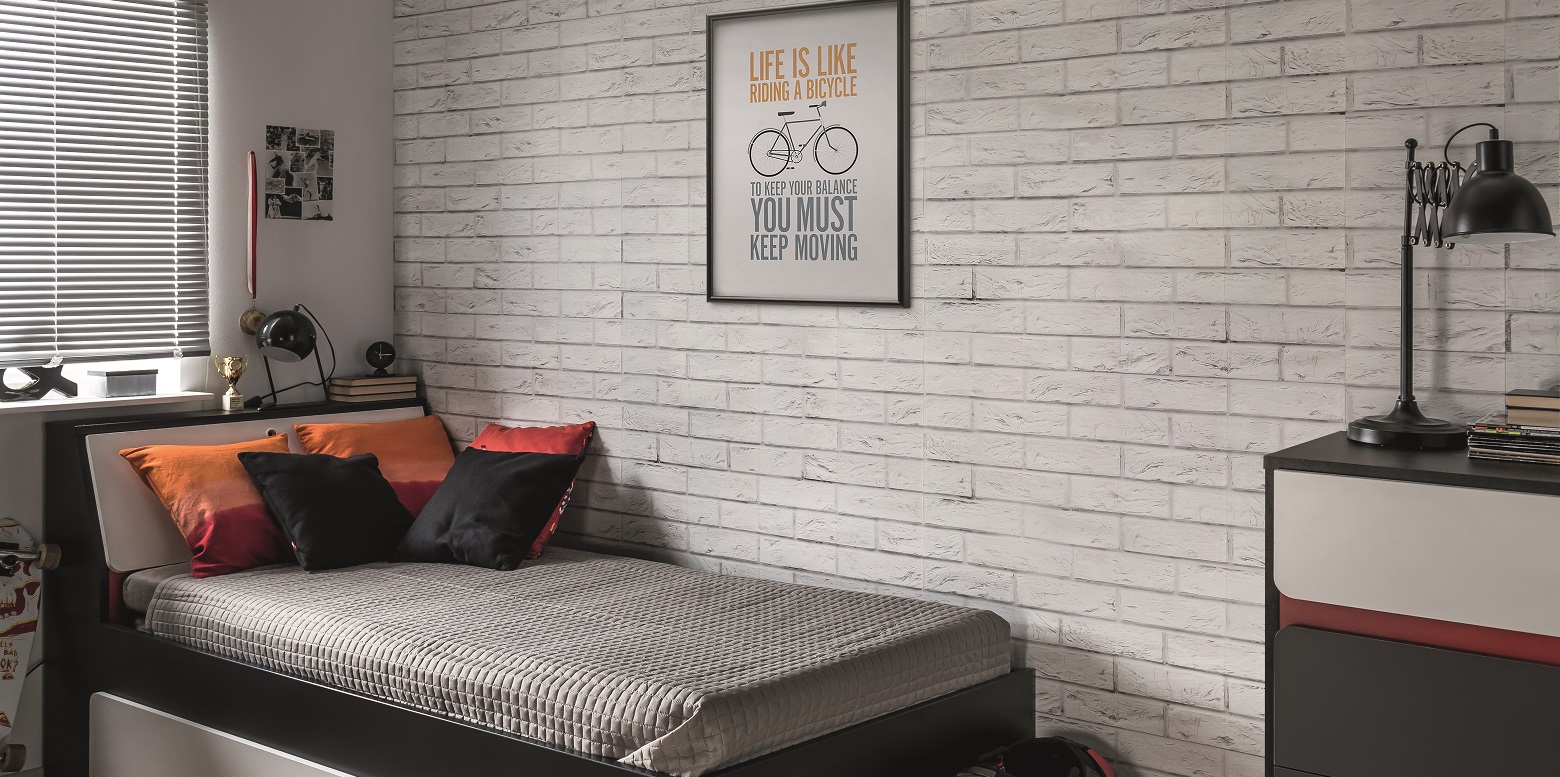
And if you want a ready-made design on the wall, you might consider a feature wall. For a teenager’s room, you could opt for a more grown-up design, such as one inspired by white, weathered brick. Check out other feature wall designs here.
Soft wall decoration. Upholstered panels in a child’s bedroom.
Or why not create a cosy atmosphere in a boy’s room with soft upholstered panels? It’s the perfect idea for an interesting interior design. But apart from their aesthetic appeal, the panels are also functional. By installing them behind the bed, you’ll create a soft headboard, making reading in bed even more enjoyable. You can also use upholstered panels to separate a study or play area, allowing you to define distinct zones within the room. Vilo’s range features panels in various shapes and colours, offering plenty of design possibilities.

What sort of furniture should you choose for a boy’s room?
The answer is: versatile and functional! The bed will probably be the largest piece of furniture in the room, so it’s worth buying one that serves an additional purpose apart from sleeping. Look for a solution with storage. You could also buy pouffes with storage space for all sorts of treasures. This will also make it easier to keep the room tidy. If you have enough storage space, consider a bed with a pull-out mattress for guests. That way, you’ll have no problem inviting friends to stay over. There are also extendable bed frames available on the market, which will come in handy as your child goes through puberty, when their height changes rapidly. To complement furniture that grows with the user, choose an adjustable desk as well.
When choosing furniture for a child’s bedroom, remember to prioritise safety. This isn’t just about safety certifications, but also the need to secure taller pieces of furniture to the wall. I imagine many of you have caught your little ones climbing onto the top shelves of a bookcase. We used to do the same ourselves, and back then, not much was said about the safety of wall units.
Create a suitable space for learning and play
When planning a study area – just as you would in an office – bear in mind the principles of ergonomics. Adhering to all these principles at home is, of course, very difficult, but there are some that are easy to adapt and will definitely improve your comfort whilst working. Firstly – proper lighting. Choose lighting that aids learning without being too bright. A well-chosen desk lamp, which provides more focused lighting, will be helpful here. Where possible, position the desk by a window so that your child has access to natural light whilst studying. Adjustable furniture, which we’ve already mentioned, will also be helpful here. It will help maintain good posture whilst working at the desk.
In very small spaces, it’s worth considering a loft bed. This will give you extra space for play. And the bed frame can encourage creativity. By attaching fabric to it, you can create a hideaway and a space just for your young family member. Also think about accessories that encourage play, such as a rug featuring streets where your son can race his toy cars. With this sort of solution, just bear in mind that such rugs aren’t ideal for those with allergies. They require more effort to keep clean.
Lighting in a boy’s bedroom
As well as the main light source, remember to include soft, spot lighting – ideally adjustable – by the bed. As well as being functional, lighting in a boy’s room can also serve a decorative purpose. Night lights come in various shapes, such as animals, stars or clouds. You could also opt for the very fashionable cotton balls, which will create a cosy atmosphere and also help your child wind down in the evening. Sometimes children are afraid of sleeping in the dark. It’s worth considering soft lighting that will provide comfort at night without encouraging late-night antics.